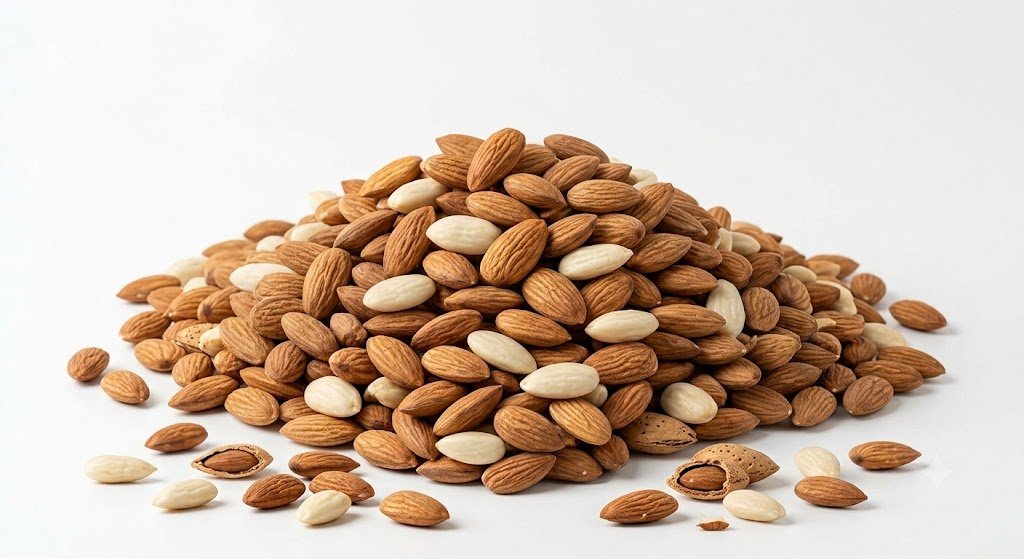

Almonds are a highly nutrient-dense functional food derived from the edible seed of the almond tree (Prunus dulcis). Distinct from true botanical nuts, these treasures are technically drupes or stone fruits containing a hard internal shell that shields a precious seed. This historic food is widely celebrated across the globe for holding an exceptional natural concentration of skin-protecting antioxidant vitamins and heart-healthy monounsaturated fats. Additionally, it features a beautifully crisp texture alongside a mild, creamy, sweet, and distinctly buttery flavor profile. For this reason, it has become a foundational culinary and functional food staple in many international markets.
Originally, the parent tree species was native to the ancient, arid, sun-drenched valleys of Iran and surrounding Middle Eastern regions. However, it was domesticated thousands of years ago during the dawn of early human agricultural tracking systems. Later on, it spread rapidly across the Mediterranean basin, Southern Europe, and the Americas through ancient maritime trade routes and monastic agricultural networks. Today, it is produced extensively across California in the United States, Spain, Australia, and Iran. Consequently, it is prized as a clean portable whole food snack, a baseline for plant-based milks, a structural texturizer for baking, and a modern longevity dietary staple.
Because it is packed with essential dietary fiber, plant protein matrices, and a massive density of fat-soluble tocopherols, this tree fruit seed is highly valued by international nutritionists. It offers incredible nutritional density alongside remarkable culinary versatility. Therefore, this comprehensive guide explores its history, nutritional profile, health advantages, traditional uses, cultivation frameworks, and practical ways to include it in your daily diet safely.
The Historic Journey of Almonds & Their Cultural Importance
This premium tree seed possesses a monumental agricultural history rooted deeply in early human civilizations and traditional wellness tracking frameworks. Over time, it spread across the globe through continuous migration and trade.
The Ancient History of Prunus Nut Seeds
- The Silk Road Staples: Early human societies traveling across central Asian trade corridors heavily relied on the shelf-stable kernels for daily survival. Growth parameters prioritized these trees because the harvested crops provided long-lasting fat energy during months of desert tracking.
- The Egyptian Royal Offerings: Ancient Mediterranean administrators highly valued the seeds as a rare luxury food asset and symbol of status. Consequently, archaeologists discovered jars filled with the raw nuts tucked securely inside the tomb of King Tutankhamun to fuel his journey through the afterlife.
- Traditional Ayurvedic Integration: Eastern holistic practitioners heavily integrated the specific properties of the fresh seeds into early daily health routines. As a result, they utilized them to boost cognitive sharpness, lubricate internal tissue matrices, and enhance cellular vitality metrics naturally.
- Modern Antioxidant Acclaim: Food scientists validated its extraordinary concentration of alpha-tocopherol in the late 20th century. Therefore, it achieved massive contemporary popularity globally as a premier functional whole food for cardiovascular protection.
Botanical Description of the Almond Tree
Prunus dulcis belongs to the rose family (Rosaceae). For instance, it is closely related to other vital orchard stone fruits like peaches, plums, cherries, and apricots rather than standard oak or hazel tree networks.
Structural Characteristics of Almond Tree Kernels
- Growth: It grows naturally as a small to medium-sized, deciduous tree. Usually, it reaches 4 to 10 meters in height and develops a rugged trunk covered in dark, scaly bark that twists gracefully over decades of orchard growth.
- Leaves: The plant produces alternate, simple, lanceolate green leaves measuring 8 to 13 cm in length. In addition, these finely serrated leaves feature a glossy upper surface that absorbs massive solar energy arrays efficiently.
- Flowers: It bears spectacular, five-petaled white or pale pink blossoms arranged in pairs along the branches during early spring. Typically, these beautiful blossoms emerge right before the leaves open, relying completely on honeybees for cross-pollination.
- The Drupe Fruit: It forms an oblong, velvety green hull that splits open vertically upon reaching full maturity. Furthermore, removing this leathery outer casing reveals a hard, pitted, woody shell that safely protects the oil-rich kernel within.
Ideal Growing Conditions for Maximum Almond Production
This plant is a classic Mediterranean crop. Therefore, it requires long, hot, dry summers and mild, wet winters to develop high nutrient values within the developing seed kernels.
- Ideal Temperature: It prefers warm growing climates between 15–32°C during the active seasonal growing cycle. However, it requires a brief period of winter chill to break bud dormancy successfully while remaining highly sensitive to early spring frosts.
- Soil Type: It thrives best in deeply drained, loose, fertile sandy loams or alluvial loams rich in organic humic matter. On the other hand, it absolutely cannot tolerate heavy, waterlogged clay that chokes away root oxygen.
- Propagation: It is regularly grown by grafting high-yielding varietal buds onto hardy seedling rootstocks within specialized nurseries. Specifically, modern orchards install drip irrigation lines to provide consistent moisture during the peak shell-filling phase.
- Harvesting Season: Farmers harvest the crop during late summer or early autumn when the green outer hulls split wide open. Specifically, they utilize mechanical trunk shakers to drop the nuts onto clean field tarps before gathering and drying them immediately.
Nutritional Profile of Raw Almonds
This unrefined seed is naturally dense in plant-based macronutrients. Furthermore, it contains high amounts of fat-soluble vitamins, essential trace minerals, and protective dietary fiber. As a result, it is a favorite among active individuals seeking sustained clean stamina tracking.
Essential Nutrients in Unrefined Raw Almonds (Per 100g serving)
| Nutrient | Amount | Health Benefits |
| Energy | 579 kcal | Natural source of dense, clean, slow-releasing metabolic energy |
| Protein | 21.2g | High plant protein density supporting structural cellular repair |
| Total Fat | 49.9g | Clean lipid matrix dominated by heart-healthy monounsaturated fats |
| Dietary Fiber | 12.5g | High fiber volume supporting exceptional gastrointestinal tracking |
| Vitamin E (Tocopherol) | 25.6mg | Massive antioxidant presence protecting cell membranes from stress |
| Magnesium | 270mg | Crucial mineral supporting deep muscle relaxation and nervous health |
| Riboflavin (Vitamin B2) | 1.1mg | Vital B vitamin assisting optimal cellular energy production curves |
Note: A single one-ounce serving easily supplies more than one-third of your daily magnesium requirements and half of your target Vitamin E needs.
Almonds Health Benefits for Your Everyday Well-being
1. Shields Cardiovascular Cells via High Vitamin E
Packed with massive concentrations of active alpha-tocopherol, it acts as a powerful fat-soluble antioxidant within the human bloodstream. Consequently, it assists the body in protecting low-density lipoproteins from oxidizing and shields arterial walls from stress.
2. Supports Elite Metabolic and Cholesterol Wellness
Features an exceptional profile of healthy monounsaturated fatty acids and dietary fiber. As a result, it assists the body in maintaining optimal, clean lipid markers and supports healthy blood sugar curves following carbohydrate meals.
3. Promotes Excellent Intestinal Health and Satiety
Its natural fibrous matrix works efficiently to nourish the gut microbiome. Specifically, regular raw intake helps encourage consistent bowel transit tracking while expanding slowly in the stomach to lower hunger signaling naturally.
4. Reinforces Skeletal and Nervous System Metrics
The abundant magnesium and calcium elements work closely with human structural tissues. For example, incorporating the seeds into your daily diet helps support bone mineralization density and facilitates calm, smooth muscle contractions.
5. Delivers Robust Dermal Layer Protection
Contains a rich combination of healthy fats and antioxidant vitamins. Whether eaten whole or utilized as a cold-pressed finishing oil, it helps reinforce deep skin moisture retention levels to combat premature aging traces.
Traditional & Modern Culinary Uses for Almonds
1. Home-Brewed Fresh Almond Milk
First, soak a cup of raw almonds in clean water for twelve hours to activate the enzymes. Then, blend the drained nuts with three cups of pure water and strain through a nut milk bag to achieve a creamy, plant-based dairy substitute.
2. Nutritious Roasted Seed Butters
Combining dry-roasted kernels inside a high-speed food processor yields a beautiful baseline. Consequently, blending them continuously for ten minutes transforms the hard seeds into a rich, spreadable paste perfect for quick macro fuel.
3. Gluten-Free Almond Flour Baking
Using finely ground blanched kernels as a direct one-to-one or partial substitute for wheat flour allows you to bake dense whole-grain goods. As a result, your items gain a beautifully moist texture and a rich, nutty flavor footprint.
4. Crisp Savory Salad Texturizers
Tossing sliced or slivered almonds with light sea salt and fresh herbs before lightly dry-toasting them in a pan produces a beautifully textured topper that enhances simple field salads.
How to Include Almonds in Your Daily Diet
- The Activation Soaking Rule: Always try to soak your raw almonds in water overnight before heavy consumption; specifically, soaking effectively neutralizes natural phytic acid and enzyme inhibitors locked inside the brown skin, maximizing mineral bio-availability.
- The Portion Control Habit: Enjoy a small handful (about one ounce or 23 kernels) as a target daily snack; specifically, keeping to regular measured servings ensures you capture all the fat-soluble vitamins without overshooting calorie goals.
- Morning Oatmeal Boosters – Chop a small handful of raw seeds directly into your warm morning porridges or chia puddings.
- Nutritious Energy Balls – Mix almond butter with oats, flaxseeds, and raw cocoa powder before rolling into healthy midday bites.
- Savory Soup Thickeners – Blend pre-soaked almonds directly into your hot vegetable lentil purees to add a luxurious, creamy body.
Side Effects & Precautions
While safe and highly beneficial for the general population, certain precautions apply:
- Consuming excessive, unmeasured quantities may contribute to a rapid surplus of daily calories due to their intense energy density.
- Choking Warning: Whole nuts possess a highly rigid physical texture; therefore, they should be finely sliced or mashed before being served to very young children.
- Allergen Note: Tree nuts are globally recognized as a primary allergen category; therefore, individuals with known sensitivities must strictly avoid the seeds to prevent cross-reactive medical events.
The Final Quality Verdict on Unrefined Raw Almonds
Ultimately, individuals seeking to maximize their daily health advantages must prioritize raw, unpasteurized, or dry-roasted variants over heavily salted, oil-fried commercial snack mixes.
Conclusion
In summary, Prunus dulcis seed is a nutrient-rich functional food celebrated for its exceptional Vitamin E profile, metabolic balance properties, and unparalleled culinary utility. From simple everyday portable snacking to home-brewed milks, flour upgrades, and raw seed butters, almonds continue to reign as a vital foundational superfood seed across the earth. Whether eaten raw as a quick macro snack or used as a clean flour substitute, they deliver fantastic life-giving value to a balanced lifestyle.
Therefore, start introducing raw almond varieties into your weekly diet planning alongside target superfoods. Ultimately, you will enjoy their distinctively rich flavor and protective properties as part of a natural, healthy lifestyle.