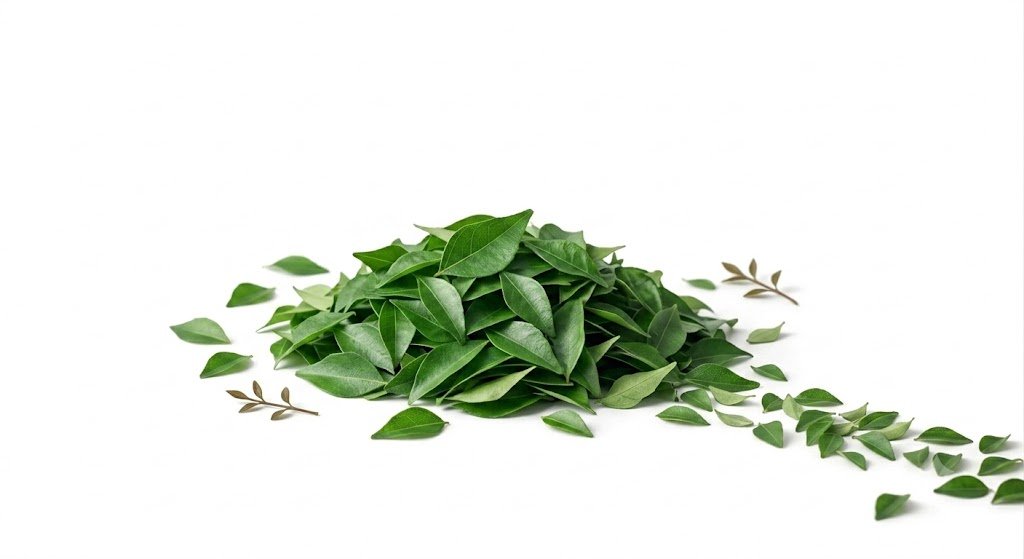

Curry leaves are a highly nutrient-dense aromatic whole food herb. They are derived from the glossy green foliage of the tropical perennial tree (Murraya koenigii). For thousands of years, global holistic health networks have valued this specialized crop as a foundational wellness asset. Visually, the raw harvested twigs feature long, pinnate leaf structures supporting small leaflets. These teardrop-shaped units shield an intensely fragrant internal volatile resin base. Furthermore, this historic food holds an exceptional natural concentration of cell-defending carbazole alkaloids.
In addition, it offers an incredible density of vision-supporting Vitamin A molecules. Fresh curry leaves display a beautifully crisp and tender texture. However, they crackle into a delightfully crunchy layer when fried in hot oils. Culturally, it carries a distinctively bright, complex, citrusy, and deeply savory flavor footprint. For this reason, it has become a baseline functional food staple in many international markets.
Originally, the parent herb species was native to the ancient, tropical ecosystems of the Indian subcontinent. It domesticated thousands of years ago during early agrarian tracking eras. Later on, it spread rapidly across Sri Lanka, Southeast Asia, and various global tropical zones. This expansion occurred through early maritime trading routes and complex migrations. Today, it is produced extensively across India, where it is known traditionally as kadi patta or sweet neem. Consequently, it is prized as a clean portable culinary accent. It serves as a foundational element for tempering savory dals and building vibrant chutneys. Therefore, modern wellness tracking systems value it as a metabolic cellular shield and a longevity dietary staple.
Because it is packed with essential dietary fiber and non-dairy calcium, this botanical herb is highly valued. It offers incredible nutritional density alongside remarkable culinary versatility. Therefore, this comprehensive guide explores its history, nutritional profile, health advantages, and practical uses.
The Historic Journey of Curry Leaves & Their Cultural Importance
This premium aromatic herb possesses a monumental historical background. It is rooted deeply in early South Asian survival and traditional planetary holistic health tracking models. Over time, it spread across the globe through continuous migration and trade.
The Ancient History of Murraya Koenigii Grass
-
The Sangam Literature Lifelines: Early human societies across Southern India documented the shiny leaves systematically as early as the 1st century. Growth parameters prioritized these home gardens because the leaves provided excellent digestive assets. Consequently, traditional kitchens integrated them into daily stews to preserve internal tracking comfort cleanly.
-
The Ayurvedic Sugar Balancers: Historical medical texts heavily documented the rapid integration of this bitter herb. For instance, ancient practitioners regularly prescribed it. As a structural wellness practice, patients chewed raw leaves to manage internal glucose tracking pathways. Therefore, they used it to maintain steady metabolic thresholds.
-
The Traditional Hair Growth Tonics: Coastal cultural networks heavily integrated the specific properties of the crushed foliage into hair conditioning customs. As a symbolic beauty asset, simmering fresh leaflets in pure coconut oil fortified scalp roots cleanly. In addition, communities used the mixture to prevent premature graying path loops.
-
Modern Carbazole Validation: Food scientists isolated its unique chemical baseline in the late 20th century. Specifically, they discovered highly concentrated mahanimbine fractions, active koenimbine pigments, and high-grade phenolic compounds. Therefore, it achieved massive contemporary popularity globally as a premier functional anti-diabetic superfood.
Botanical Description of the Sweet Neem Tree
Murraya koenigii belongs exclusively to the citrus and rue family (Rutaceae). This makes it a close relative to oranges, lemons, and kumquats. For instance, it grows naturally as a small, fragrant tropical tree. Thus, it remains completely separate from dryland wheat fields or low-lying desert turf grass beds.
Structural Characteristics of Unrefined Curry Leaves
-
Growth: It grows naturally as a small shrub or semi-tall tree. Usually, it reaches 4 to 6 meters in height under ideal tropical weather configurations. It sends up slender, dark green trunks anchored by deep root matrices.
-
Leaves: The plant produces alternate, pinnate structural stems measuring 20 to 30 cm in length. In addition, each stem hosts 11 to 21 asymmetric, pointed leaflets. This layout captures hot solar energy arrays efficiently to fuel lower bark expansion loops.
-
Flowers: It bears compact, terminal clusters of small, tubular white blossoms displaying an intensely sweet scent. Typically, these beautiful flowers open during bright spring heat fields to attract flying tracking insects. Therefore, they quickly set small, dark purple berry fruits cleanly.
-
The Volatile Leaflet: It forms hundreds of structured, shiny green leaves holding abundant essential oil glands across their surfaces. Furthermore, these dense outer tissues function as primary storage vaults. They protect the plant’s essential terpenes and active mineral matrices safely.
Ideal Growing Conditions for Maximum Curry Leaves Yield
This plant is a sun-loving, highly frost-sensitive seasonal crop. Therefore, it requires high ambient warmth, moderate soil dampness, and well-drained soil environments to complete its leaf lifecycle successfully.
-
Ideal Temperature: It prefers hot, humid growing climates between 22–32°C for optimal stalk extension. This warmth optimizes subsequent volatile oil synthesis cycles. However, it absolutely cannot tolerate winter frosts. In addition, freezing drafts can turn the foliage black instantly.
-
Soil Type: It thrives best in well-drained, loose fertile loams or alluvial sandy loams rich in organic humic matter. On the other hand, it cannot tolerate highly compacted clay layers that trap stagnant root moisture fields.
-
Propagation: It is regularly grown from fresh seeds or propagated easily from semi-ripe stem cuttings rooted directly in loose field soil. Specifically, modern organic setups ensure continuous terminal tip pruning. They pinch away early blossoms to encourage dense lateral branch tracking loops cleanly.
-
Harvesting Season: Farmers harvest the mature crop continuously throughout the warm summer months by stripping the leaflets cleanly from the main stalks. Specifically, they gather the fresh twigs during early morning hours. This timing ensures the internal volatile oil matrices maintain their peak aromatic weight.
Nutritional Profile of Fresh Curry Leaves
This unrefined culinary herb is naturally dense in vital minerals. Furthermore, it contains high amounts of plant fiber, beta-carotene, and protective volatile compounds. As a result, it is a favorite among active individuals seeking sustained clean stamina tracking.
Essential Nutrients in Curry Leaves Matrices (Per 100g raw leaf serving)
| Nutrient | Amount | Health Benefits |
| Energy | 108 kcal | Source of intense, active, calorie-friendly micronutrient density |
| Total Carbohydrates | 18.7g | Stable complex carbohydrates providing sustained energy tracking |
| Dietary Fiber | 6.4g | Clean fiber volume supporting exceptional gastrointestinal tracking |
| Protein | 6.1g | High plant protein density supporting structural cellular repair loops |
| Calcium | 830mg | Non-dairy mineral presence supporting deep skeletal safety loops |
| Iron | 0.9mg | Vital mineral supporting healthy red blood cell oxygen carrier loops |
| Vitamin A (Beta-Carotene) | 7560µg | Record-breaking vitamin levels shielding visual and skin tissue layers |
Note: Boasting a remarkably dense mineral layout, a handful of fresh sprigs packs more calcium than an equivalent volume of whole dairy milk. (Source: USDA FoodData Central)
Curry Leaves Health Benefits for Your Everyday Well-being
1. Drives Blood Sugar Regulation via Mahanimbine
Packed with massive concentrations of active carbazole alkaloids, it functions as a highly effective inhibitor of alpha-glucosidase digestive enzymes. Consequently, it assists the body in delaying carbohydrate breakdown. Furthermore, it supports healthy post-meal glycemic tracking paths cleanly.
2. Protects Vision and Macular Integrity via Vitamin A
Features an exceptional profile of active beta-carotene plant pigments. Because these specialized elements actively convert into usable retinol inside the human body, it assists the body in nourishing eye lens fabrics. Therefore, it shields visual paths from night blindness stress safely.
3. Calms Gastrointestinal Motility and Bloating Friction
Its unique combination of bitter components and volatile oils works efficiently to stimulate active hepatic bile flow. Specifically, regular whole-leaf intake helps relax smooth stomach muscle linings. Consequently, it encourages smooth digestive transit tracking loops.
4. Retards Cellular Aging via High Alkaloids
Contains a remarkable volume of active phenolic antioxidants working in perfect cross-reactive synergy with cellular networks. For example, incorporating the leaves into daily templates neutralizes free radicals. Therefore, it guards long-term metabolic balance profiles cleanly.
5. Supports Hair Vitality and Scalp Nourishment
The abundant amino acids and trace iron minerals work efficiently to fuel hair follicle root cells. Specifically, it provides the essential blocks the body utilizes to reinforce external keratin shields. Therefore, it allows active individuals to maintain consistent scalp stamina tracking smoothly.
Traditional & Modern Culinary Uses for Curry Leaves
1. Authentic South Indian Savory Tempering Dals
First, measure two tablespoons of refined high-oleic oil into a warm skillet. Then, toss in a teaspoon of mustard seeds and ten whole fresh curry leaves. Cook continuously for 30 seconds until the leaves crackle loudly. After that, pour this aromatic mixture directly over boiled lentils to build an elite baseline flavor.
2. Zesty Fresh Coconut and Herb Chutneys
Combining one cup of freshly grated coconut meat systematically with roasted chana dal, ginger, green chilies, and five raw leaves inside a food processor yields a beautiful mix. As a result, blending for 3 minutes creates a luxurious dip. Furthermore, it develops a deep savory footprint.
3. Aromatic Herb Infused Clarified Butter
First, melt a half-cup of pure grass-fed ghee in a small pan. Next, drop a handful of clean dried leaflets directly into the warm fat for 2 minutes. This process produces a smooth finishing liquid. Consequently, this layout acts as an excellent, nutrient-dense antioxidant cooking asset.
4. Crisp Baked Herb Salad Chips
Tossing your whole fresh leaves with cold-pressed oil and sea salt before baking them for 5 minutes forms a fantastic crunchy topping. This allows your midday meals to capture a beautiful textured depth. In addition, it delivers a rustic nutritional tracking profile.
How to Include Curry Leaves in Your Daily Diet
-
The Hot Oil Tempering Rule: Always introduce your fresh leaves straight into hot oil grids right along with your mustard seeds at the absolute start of cooking; specifically, thermal fat contact quickly bursts the leaf oil glands to distribute the carbazole payload cleanly through the entire meal matrix.
-
The Whole Consumption Habit: Try to chew and swallow the cooked leaves instead of discarding them on the edge of your plate; specifically, eating the whole fiber casing ensures you lock in 100 percent of the active calcium and iron benefits.
-
Morning Wellness Infusions – Simmer 5 clean leaves in a cup of pure water with lemon to create a morning digestive tonic. Therefore, you can easily vary your macro tracking.
-
Nutritious Hummus Boosters – Blend fried leaves directly into your homemade chickpea or white bean dips. In addition, this adjusts your flavor layout.
-
Warming Soup Enrichers – Drop a handful of ground leaf powder straight into your simmering vegetable purees right before serving. Consequently, you will add excellent herbal depth to the dish.
Side Effects & Precautions
While safe and highly beneficial for the general population, certain precautions apply:
-
Consuming standard culinary quantities is exceptionally safe, but extracting massive therapeutic supplemental doses should be approached mindfully.
-
Fresh Wash Note: Raw garden leaves harvested from low branches can collect loose field dust or organic tracking elements; therefore, individuals tracking clean gastrointestinal paths should wash them under running water exclusively.
-
Store your fresh unpeeled stems inside a zip-lock bag placed within the refrigerator crisper drawer; specifically, stripping them away from the central twig before storage causes rapid drying and staleness.
The Final Quality Verdict on Unrefined Curry Leaves
Ultimately, individuals seeking to maximize their daily health advantages must prioritize fresh, vibrant green sprigs over oxidized, brown commercial dried flakes that have lost their vital volatile compound payload. They should select clean homegrown leaves over mass-market versions exposed to chemical storage sprays.
Conclusion
In summary, Murraya koenigii is a nutrient-rich functional food. It is celebrated for its exceptional carbazole alkaloid matrix, eye-protecting Vitamin A, and unparalleled culinary utility. From simple everyday temperings to zesty chutneys, infused ghees, and crisp salad toppings, curry leaves continue to reign as a vital foundational superfood herb across the earth. Whether eaten as a fresh crispy fried finish or blended into warm winter dals, it delivers fantastic value to a balanced lifestyle.
Therefore, start introducing raw curry leaf varieties into your weekly diet planning alongside target superfoods. Ultimately, you will enjoy their distinctively rich flavor and protective properties as part of a natural, healthy lifestyle.