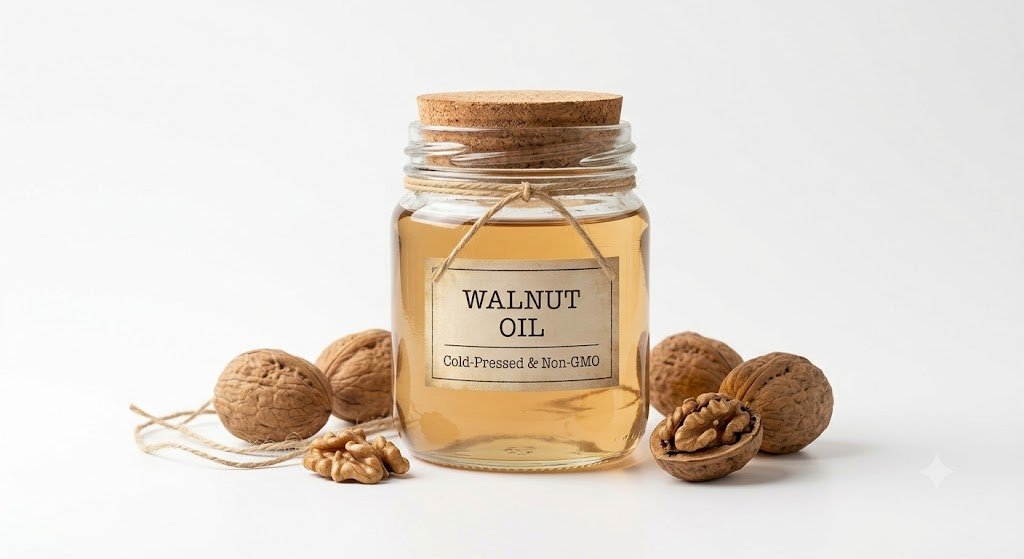

Walnut oil is a highly nutrient-dense natural fat extracted from the dried kernels of the English walnut tree (Juglans regia). Specifically, this premium liquid lipid is obtained primarily through careful cold-pressing mechanical methods to fully protect its highly delicate chemical architecture from destructive heat exposure. This historic fat is widely celebrated across the globe for holding a high natural concentration of brain-supporting essential fatty acids and specialized plant polyphenols. Additionally, it features a beautifully pale golden color, a clear viscosity, and an intensely rich, deeply roasted, buttery nut aroma profile. For this reason, it has become a foundational culinary and functional fat staple in many international markets.
Originally, the parent tree species was native to the ancient, temperate mountain valleys stretching from the Balkans across Central Asia to the foothills of the Himalayas. However, it was domesticated thousands of years ago during early agrarian trade expansions. Later on, it spread rapidly across western Europe, North Africa, and the Americas through ancient Roman trade networks and modern agricultural pathways. Today, it is produced extensively across China, California, France, and Eastern Europe. Consequently, it is prized as an elite raw finishing oil, a foundational baseline for delicate cold sauces, a metabolic nutrient enhancer, and a modern neurological wellness supplement.
Because it is packed with essential polyunsaturated fatty acids, protective fat-soluble vitamins, and a massive volume of alpha-linolenic acid (ALA), this nut-derived fat is highly valued. It offers incredible nutritional density alongside remarkable culinary versatility. Therefore, this comprehensive guide explores its history, nutritional profile, health advantages, traditional uses, cultivation frameworks, and practical ways to include it in your daily diet safely.
The Historic Journey of Walnut Oil & Its Cultural Importance
This premium tree lipid possesses a profound agricultural history rooted deeply in early European artistic traditions and ancient medicinal tracking models. Over time, it spread across the globe through continuous migration and trade.
The Ancient History of Juglans Seed Natural Fats
- The Royal Persian Legacy: Early human societies across ancient Persia highly valued the rich kernels as a supreme luxury food asset. Growth parameters prioritized these massive trees because the resulting oils sustained local populations through cold winter cycles.
- The Classical Renaissance Palette: Historical European masters heavily utilized the unrefined fat as a primary drying medium for fine oil paints. Consequently, world-famous Renaissance artists preferred it over linseed blends because it dried with extreme clarity without yellowing over the centuries.
- Traditional Chinese Medical Systems: Ancient holistic physicians heavily integrated the distinct properties of the fresh seed lipids into early cognitive recipes. As a result, practitioners regularly utilized it to optimize sluggish circulatory networks and balance systemic neurological vitalities.
- Modern Neurological Validation: Global scientists isolated its unique polyunsaturated fat matrix, particularly its high alpha-linolenic acid levels, in the late 20th century. Therefore, it achieved massive contemporary popularity globally as a premium plant-based brain superfood fat.
Botanical Description of the Walnut Oil Tree
Juglans regia belongs to the Juglandaceae family. For instance, it grows naturally as a massive, long-lived deciduous tree completely separate from standard commercial seed or grain fields.
Structural Characteristics of Walnut Nut Lipids
- Growth: It grows naturally as a large, wide-canopied, long-lived deciduous tree. Usually, it reaches 25 to 35 meters in height and develops a massive trunk covered in smooth, silvery-gray bark that develops deep fissures over decades.
- Leaves: The plant produces large, alternate, pinnate green leaves measuring 25 to 40 cm in length. In addition, these compound leaves feature 5 to 9 individual oval leaflets that give off a clean, citrus-herbal fragrance when crushed.
- Flowers: It bears separate male and female blossoms on the same branch structure during late spring. Typically, the male flowers form long, drooping green catkins, while the female blossoms emerge in small clusters, relying entirely on wind patterns for cross-pollination.
- The Nut Fruit: It forms a green, fleshy, fibrous outer husk that encloses a hard, wrinkled, woody inner shell. Furthermore, splitting this structural shell open reveals the heavily convoluted, oil-rich kernel that directly resembles the human brain matrix.
Ideal Growing Conditions for Maximum Walnut Oil Production
This plant is a temperate, frost-hardy tree crop. Therefore, it requires a distinct winter chilling period followed by long, warm summers to develop high oil percentages within the developing kernels.
- Ideal Temperature: It prefers moderate growing climates between 15–28°C during the active growing phase. However, it requires hundreds of winter chilling hours below 7°C to break bud dormancy successfully each spring.
- Soil Type: It thrives best in deeply drained, loose, fertile alluvial loams or deep river silt soils with an optimal neutral pH. On the other hand, it absolutely cannot tolerate shallow soils or highly waterlogged roots that trigger root asphyxiation.
- Propagation: It is regularly grown by grafting high-yielding varietal buds onto hardy seedling rootstocks within specialized nurseries. Specifically, trees require close monitoring for the first five years until their deep taproot networks anchor firmly.
- Harvesting Season: Farmers harvest the mature crop during early autumn when the green outer husks split open naturally. Specifically, they utilize mechanical trunk shakers to drop the nuts onto clean tarps before hulling and drying the shells immediately.
Nutritional Profile of Raw Walnut Oil
This cold-pressed nut fat is naturally dense in essential polyunsaturated fatty acids. Furthermore, it contains high amounts of fat-soluble vitamins and active protective plant polyphenols. As a result, it is a favorite among active individuals seeking sustained clean stamina tracking.
Essential Nutrients in Unrefined Walnut Oil (Per 100g serving)
| Nutrient | Amount | Health Benefits |
| Energy | 884 kcal | Natural source of dense, clean, slow-releasing metabolic energy |
| Total Fat | 100.0g | 100% pure lipid matrix completely free of proteins and carbohydrates |
| Alpha-Linolenic Acid (Omega-3) | 10.4g | Exceptionally high plant omega-3 content supporting brain tissue health |
| Linoleic Acid (Omega-6) | 52.9g | Essential polyunsaturated fatty acid supporting structural cell repair |
| Oleic Acid (Omega-9) | 22.2g | Healthy monounsaturated fatty acid supporting overall lipid balance |
| Saturated Fat | 9.1g | Stable structural lipids present in low, balanced natural proportions |
| Vitamin E (Tocopherol) | 0.4mg | Powerful fat-soluble antioxidant protecting cell membranes from stress |
Note: Sourced directly from unrefined mechanical cold-pressings, it holds a highly concentrated volume of polyunsaturated fats, with a single tablespoon easily fulfilling your daily plant omega-3 requirement. (Source: USDA FoodData Central)
Walnut Oil Health Benefits for Your Everyday Well-being
1. Optimizes Cognitive Vitality via High ALA Monolayers
Packed with massive concentrations of alpha-linolenic acid, it provides the essential fat blocks needed to reinforce brain cell membranes. Consequently, it assists the body in supporting smooth neural communication loops and shields brain networks from chronic oxidative stress.
2. Lowers Systemic Cardiovascular Inflammation Markers
Features an exceptional volume of polyunsaturated lipids alongside active ellagitannin polyphenols. As a result, it assists the body in maintaining optimal, clean blood pressure curves and shields low-density lipoproteins from dangerous vascular oxidation.
3. Nourishes Dermal Layers and Fights Dry Skin
The abundant essential fatty acid elements work closely with human skin tissue structures. For example, regular dietary intake helps reinforce deep moisture retention metrics, smoothing out rough patches and boosting skin barrier elasticity.
4. Supports Healthy Metabolic Balance Profiles
Its unique lipid matrix works efficiently with metabolic tracking models. Specifically, incorporating small regular doses into your food templates helps support stable fasting blood sugar metrics and encourages healthy endothelial lining functions.
5. Delivers Robust Protective Polyphenol Shielding
Contains notable levels of active plant tannins and sterols. Because these specialized compounds aggressively neutralize circulating free radicals, they help shield vascular systems from premature cellular aging.
Traditional & Modern Culinary Uses for Walnut Oil
1. Cold Finishing Drizzles with Walnut Oil
First, prepare a warm bowl of roasted root vegetables, wild rice, or creamy butternut squash soup. Then, drizzle a single tablespoon of raw walnut oil directly over the food right before serving to fully protect the delicate omega-3 bonds.
2. Classic French Gourmet Salad Dressings
Combining three parts cold-pressed walnut oil with one part fresh lemon juice, a teaspoon of Dijon mustard, and a pinch of sea salt yields a beautiful mix. Consequently, whisking them creates a delicious dressing that pairs perfectly with bitter greens.
3. Wholesome Whole Grain Baking Enhancements
Using the oil as a clean one-to-one liquid substitute for processed seed oils allows you to bake dense whole-grain breads or muffins. As a result, your items gain a beautifully moist texture and a rich, toasted nutty aroma.
4. Nutritious Cold Pasta Accent Spreads
Tossing fresh whole-grain pasta with a splash of walnut oil, minced garlic, and fresh herbs creates an excellent baseline that completely eliminates the need for processed dairy bases.
How to Include Walnut Oil in Your Daily Diet
- The Strict Fridge Storage Rule: Always store walnut oil securely in a cool, dark refrigerator once opened, and never apply direct cooking heat to it; specifically, exposure to ambient heat or frying pan frying instantly destroys the fragile omega-3 bonds, turning the oil bitter and rancid.
- The Raw finishing Habit: Prioritize utilizing this premium oil raw rather than for active frying tasks; specifically, consuming it raw ensures you capture 100 percent of the active anti-inflammatory plant polyphenols.
- Morning Oatmeal Stir-Ins – Drizzle a teaspoon of golden walnut oil directly into your warm morning porridges or amaranth bowls.
- Nutritious Dip Boosters – Stir a tablespoon into your homemade white bean hummuses or avocado mashes before serving.
- Fruit and Nut Toppings – Drizzle a light touch over sliced crisp pears or apples for a quick, brain-boosting midday macro snack.
Side Effects & Precautions
While safe and highly beneficial for the general population, certain precautions apply:
- Consuming excessive, unmeasured quantities may contribute to a rapid surplus of daily calories due to its intense energy density.
- Frying Pan Warning: This oil has a very low tolerance for heat; therefore, it must absolutely never be used for high-heat frying, searing, or deep sautéing to prevent dangerous oxidation loops.
- Allergen Warning: Walnuts are globally recognized as a primary tree nut allergen; therefore, individuals with known nut sensitivities must strictly avoid the oil to prevent cross-reactive events.
The Final Quality Verdict on Unrefined Walnut Oil
Ultimately, individuals seeking to maximize their daily health advantages must prioritize fresh, cold-pressed, dark-bottled variants over cheap ambient shelf vegetable oil blends. (Source: Wikipedia: Walnut Oil)
Conclusion
In summary, Juglans regia extract is a nutrient-rich tree fat celebrated for its exceptional alpha-linolenic acid profile, cognitive protection, and unparalleled gourmet finishing utility. From simple salad dressing enhancements to cold finishing drizzles and wholesome baking additions, walnut oil continues to reign as a vital foundational superfood fat across the earth. Whether used as a simple structural brain nutrient or a daily longevity tonic, it delivers fantastic life-giving value to a balanced lifestyle.
Therefore, start introducing raw walnut oil varieties into your weekly diet planning alongside target superfoods. Ultimately, you will enjoy its distinctively rich flavor and protective properties as part of a natural, healthy lifestyle.